If you are not familiar with a psychological phenomenon called the mere-exposure effect or familiarity principle, you can read more about it in this Wikipedia article. I am using it rather jokingly, as a conversation starter for this week’s Saturday Question.

Saturday Question #43:
Are There Mere-exposure Effect Perfumes in Your Collection?
The idea behind that phenomenon was: “After repeated exposure, the observing organism will begin to react fondly to the once novel stimulus.”
Do you have any perfumes that you like more now then you liked them when you first bought them or got them as a gift? We’re not talking about the situation when you tested a sample or a small decant, didn’t like it, then tested more, liked and bought perfume. Or didn’t like perfume initially then tested years later and fell in love.
Can you think of any perfume that you liked but didn’t love … until you got used to it?
My Answer
I knew I would buy Annick Goutal Nuit Etoilee as soon as I saw an announcement about its launch: I liked the brand, I was very partial to their old-style colored bottles, and especially I liked that dark blue color. So, once I found it at a store, I bought it. It wasn’t a blind buy, I liked it, but at that time there were so many other great perfumes that Nuit Etoilee seemed somewhat simple and … not challenging (?). It wasn’t a statement perfume (I gravitate to those). And for a while I thought that it reminded me of Serge Lutens Fille en Aiguilles. I even solicited blind testing experiment from three fellow-parfumistas (if you weren’t around then and curious or want to read objective impressions of this perfume from reviewers who didn’t know what they were testing, take a look: Déjà vu, Episode 4: des pairs, dis-pair, Despair).
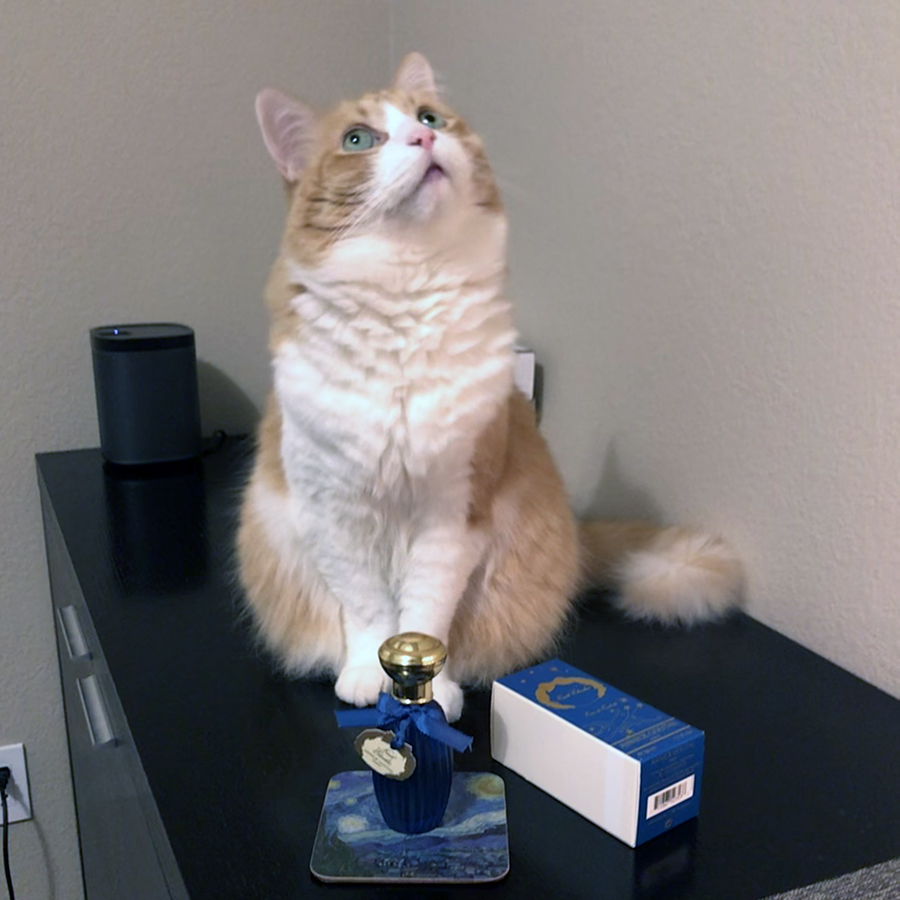
Starry Night? Where?!!
I wore Nuit Etoilee for a while, but then somehow forgot about it and didn’t wear it for at least 4 years. I didn’t change my mind about it. I didn’t dislike it. I just never chose to wear it.
A couple of months into the lockdown, I thought of wearing it – I don’t remember what prompted it. It was almost a shock: I liked it very much. It surprised me. What was that? Have my tastes changed? Does this perfume seem so much better now compared to endless modern concoctions? Or was it a true case of the mere-exposure effect?
[…] analysis found that the effect is strongest when unfamiliar stimuli are presented briefly. Mere exposure typically reaches its maximum effect within 10–20 presentations, and some studies even show that liking may decline after a longer series of exposures. For example, people generally like a song more after they have heard it a few times, but many repetitions can reduce this preference. A delay between exposure and the measurement of liking actually tends to increase the strength of the effect.